what
The nervous system is the bridge between brain and body. It is the main interfacing system of the human organism; you could think of it like the conductor in an orchestra. All other systems in your organism connect to and are in relationship with your nervous system, including your digestive, immune, endocrine, lymphatic, cardiovascular and musculoskeletal systems.
Whenever you experience anything in life, the imprints of that experience land first and are held in your nervous system. The nervous system therefore holds the key to mind-body integration and wellness, as well as to liberating ourselves from stress and trauma.
what is dysregulation?
When we undergo a stressful or traumatic event or period in life, the nervous system automatically and intelligently puts us into survival states to ensure our safety. These states originate in the oldest parts of our brain and are instinctive responses that kept our evolutionary ancestors alive over millennia. They include:
- mobilisation or activation: increased energy availability in the body so we can stand our ground, run away, or fight back
- correlates with and can feel like anxiety, fear, anger or panic
- dissociation or shutdown: decreased energy availability in the body that brings us into collapse, disconnects us from the horror of whatever we are experiencing, or allows us to keep functioning without getting overwhelmed by feeling
- correlates with and can feel like depression, grief or disconnection
- some combination of the previous two (freeze, fawn, or appease)
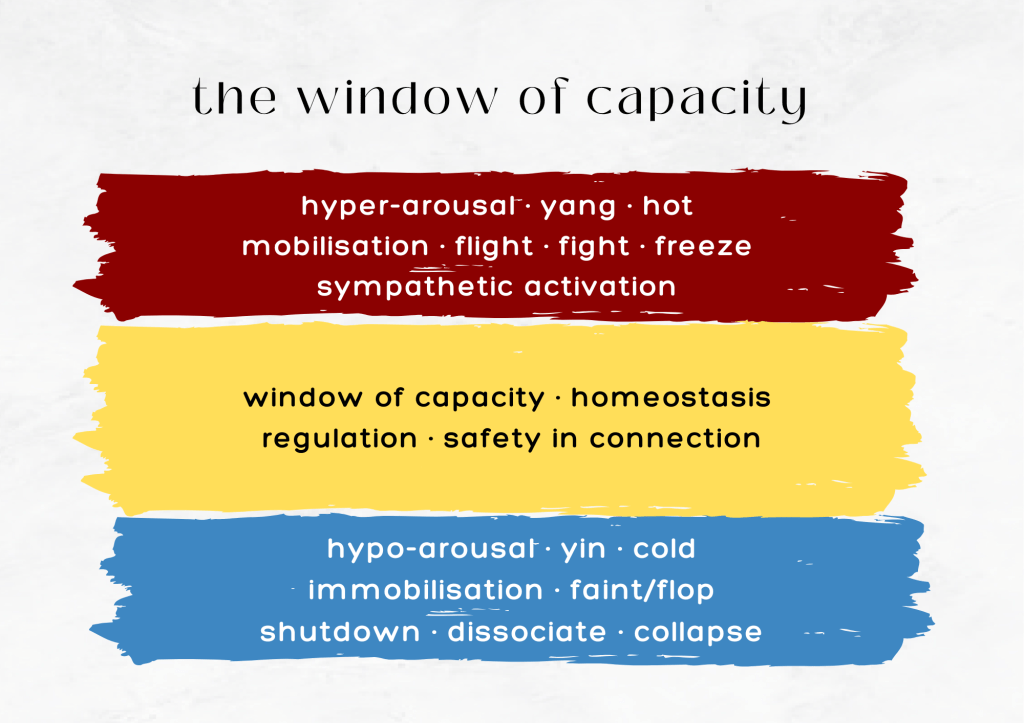
Coming into and out of these states is a normal part of life. A healthy nervous system is able to flexibly move through such states to support the demands of life. Dysregulation only occurs when we get stuck in one or more of these states, or stuck in a pattern of cycling through these states one after another, continuously.
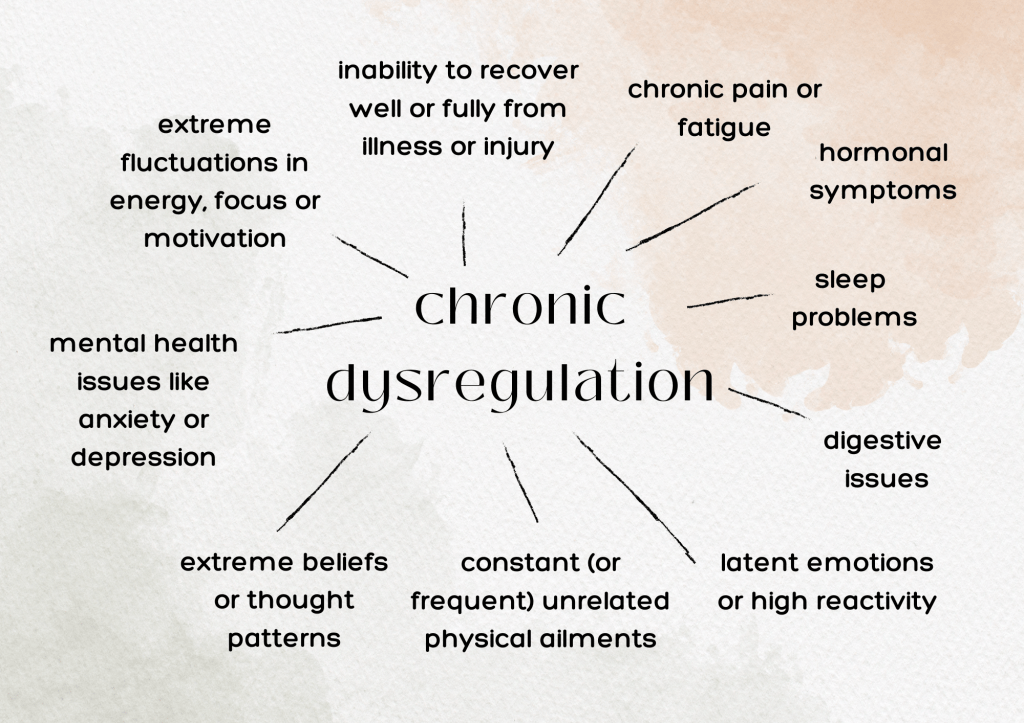
Because of its interconnectivity with so many other physiological systems, the nervous system is implicated in a wide range of conditions that we often describe as ‘stress-related’ or stress-triggered. Chronic dysregulation impacts all aspects of our functioning and life, including but not limited to:
- low or fluctuating mood or energy levels, motivation and focus
- poor digestion, sleep, movement and rest
- inflammation, pain sensitivity and tolerance, and inhibited recovery
- low immunity and hormonal fluctuations
- emotional dysregulation, including anxiety, anger and depression
- sensory issues and sensitivities (overwhelm)
- difficulties with memory, learning, communication and information processing
- unhelpful and limiting beliefs about oneself, others and the world
- spiralling thought patterns of anxiety, panic, shame or doom
All of these are experiences stem from the state of the body and the nervous system, and so are most helpfully addressed on that level, rather than by thinking about or analyzing them cognitively. You can’t shift the state of your nervous system with words alone.
why
All of our life’s experiences are rooted in our neurobiology, from our earliest attachments and wounds through to the peak moments and life-altering traumas of adult life. Working on the level of the nervous system means we can access patterns and possibilities at their source.
This in turn means we get to the root of where the issue is actually coming from, and are able to shift it by providing the nervous system the resources and new experiences it needs to choose a different possibility.
When we feel safe enough, we can access the best parts of ourselves: our creativity, clarity, compassion, curiosity and courage.
Nervous system work is rooted in self-understanding, self-acceptance and working with rather than against yourself. Accessing the deeper intelligence of the body and nervous system is, in and of itself, healing and clarifying, because it puts us in touch with reality and shows us how we feel and what to do about it.

how it works
Working with the nervous system involves first understanding its responses and the way it communicates with us. As a system that operates below the neocortex (thinking mind), the nervous system is best accessed through bodily or somatic experience: sensation, posture, breath, movement, sensory experience and felt sense.
Once we are able to understand ourselves on this level, it opens up the possibility for greater self-acceptance and therefore, for true and authentic change from the inside out.
One of the biggest gifts of nervous system work is being able to understand why you respond the way you do, and to accept those responses without judgement. This is the first step and the necessary precondition to being able to change those responses.
The next step after understanding is experiential: we offer our nervous system resources and practices that allow it to feel safe in the here and now. Over time and with practice, we build the capacity to remain present and to be more at ease with what we experience. In the process, we also invite the nervous system to resolve and complete stuck responses, and to let go of old habits and patterns that we no longer need.
The patterns that govern nervous system states and behaviours are dynamic and change-able, given the right conditions. By supporting the nervous system to move flexibly into and out of states of safety, hyper- and hypo-arousal, the body returns to homeostasis while neuroplastic change happens in the brain. This in turn widens our tolerance and capacity, so we feel safer and more at ease with more and more of life’s experiences.
a note about the process
Nervous system regulation is unique in the landscape of inner work in that it is oriented around ease, safety, connection, pleasure and relaxation (ie. resourcing). Accessing these states of being reliably and repeatedly is what allows the nervous system to finally downshift and recover from periods of prolonged stress and trauma. Resourcing tends to be an enjoyable practice, because it feels good to the body and brain to be in safety and connection, and very often, it is just what the body and nervous system have been begging for all along.
Our resistance to or avoidance of inner work often comes down to a lack of capacity rather than an issue of willpower. A nervous system that is regulated, resourced and has capacity—by definition—feels safe enough to approach difficult things, and will bring more calm and security into difficult experiences.
The hard part of this work is slowing down enough, being patient and understanding enough, to keep showing up and following through with these practices. Neuroplastic change occurs incrementally through repeated, consistent practice, specifically practice that attunes and provides a felt sense of safety; it is not a one-and-done. The tools and the skills of resourcing and regulation are skills for life.

practicalities
I offer nervous system-oriented coaching both in groups and through 1-1 sessions.
classes + workshops
I’m available to lead a group workshop or class series for a group of your choosing. Please reach out to find out more and organize something suitable.
1-1 sessions
We generally begin with an intake call or session to get a sense of where you’re coming from and what you need. After that, sessions will be around an hour each, at a frequency of your choosing (I usually recommend weekly where possible). Sessions can be done in-person or online via audio or video call.
In each session, I will introduce you to a theme or idea about the nervous system, and guide you through one or more nervous-system regulation practices that you can take home with you and do as and when you need to. We also keep time for you to track your own states and progress, and reflect on what you’re learning from your own nervous system. These pre- and post- practice coaching times are the most valuable moments for you to integrate and deepen your own sense of partnership with your body and nervous system.
In 1-1 coaching, you really get a chance to individualise your approach and ask the questions that come up for you as you evolve in this work. I’d recommend 1-1s if you’re going through any nervous-system related issues or illnesses, or in general if life is getting a lot and you know that you need personalised support that is nervous-system informed.

